Dimensions that appear bold indicate there is a large difference between the cultural orientations of the two countries with the likelihood that the issues will be significant. Italics will indicate a medium difference.
Clicking on an issue will open a right side-bar which describes the underlying cultural dimension in terms of observable behaviors and expectations of individuals from the country under consideration. Clicking an issue will also open a gray box immediately below, which describes why people feel this way and how to overcome the reaction.
Americans Are Uncomfortably Aggressive
Why Japanese Feel This Way About Americans
Individuals from cultures with an Indirect Orientation are not accustomed to being verbally directly contradicted or disagreed with, or confronted. This is even more true in public than in private, but is still true in private. Direct contradiction, disagreement, or confrontation feels to such individuals like a slap in the face.
How To Successfully Work Together
This does not mean that you cannot contradict, disagree with , or confront an Individual who has an Indirect orientation. To do so however be sure and use extremely diplomatic and round-about phrasing. Contradicting, disagreeing with, or confronting such an Individual should also be done with words that show your humility. When done in this fashion, the message will get through but will not feel like a slap in the face or aggressive confrontation
Americans as Subordinates Are Insubordinate
Why Japanese Feel This Way About Americans
In cultures with a Hierarchy orientation, what can, should not, and must be said or done between managers and subordinates is clearly defined and understood by all those from that culture.
If subordinates violate these unwritten rules managers will probably consider subordinates to be insubordinate.
If managers do not adhere to these rules subordinates will probably consider their managers to be incompetent
Subordinates in cultures with a Hierarchy orientation usually are not supposed to contradict their managers or in any way imply that their managers have made a mistake. Subordinates in cultures with a Loosey-Goosey orientation are expected to freely express disagreement and to correct perceived errors in logic or direction. Hence the impression of managers with hierarchy orientation that such subordinates are insubordinate.
How To Successfully Work Together
Managers from cultures with a Hierarchy orientation who are placed in a position of managing subordinates from cultures with a Loosey-Goosey orientation may try to document, either in writing or in one-on-one meetings, the unwritten rules of what can and cannot be said or done.
A better approach, however, might be to meet with your staff, explain to them what your expectations are and attempt to get their feedback.
This may feel uncomfortable, because your Loosey-Goosey staff will likely say things that feel to you like insubordination. Try to keep in mind that your staff is NOT being insubordinate, they are saying and doing what is deemed appropriate in their own culture.
Americans managers are incompetent
Why Japanese Feel This Way About Americans
Subordinates from cultures with a Hierarchy orientation especially if combined with a High Power Distance orientation will expect their managers to be experts and will expect their managers to give concise direction almost in the form of unequivocal decrees. Subordinates from cultures with this orientation KNOW it is in appropriate even bordering on insubordination to question any portion of the directive.
If asked to comment on the directive they will have little if anything to say other than to agree, even if they disagree or do not understand the directions they are given.
If such subordinates are not given clear direction or are asked for their opinion concerning the directive they will start to wonder if their manager has enough experience or expertise to be effective, in other words they will wonder if their manager is competent!!
How To Successfully Work Together
Accommodation may be the easiest strategy to adopt in this situation. If you are not a subject matter expert in the area you are managing, attempt to identify experts from the home office who can help you know enough to provide the direction and reasonable time frames for implementation that you can then pass along to your subordinates.
Consider the specific situation and your and your company’s goals. If the goals are to involve local staff in global activities, a degree of training may be required to introduce local staff to more Loosey-Goosey management approaches and greater staff participation. Such training can be coupled with other HR programs that affect individual and group compensation or other rewards. These will reenforce the new corporate values by rewarding those who are willing to overcome their own cultural tendencies of acceptance in favor of greater participation.
Americans as Subordinates Are Disrespectful
Why Japanese Feel This Way About Americans
In cultures with a highPower Distance Index one must be very careful in what one says to someone of higher status, such as a manager, and how one says things to someone of higher status.
Often it is considered disrespectful to contradict a manager in public (no matter how humbly and round-about you phrase the contradiction).
Often cultures with a high Power Distance Index incorporate consideration for status into their language, for example the French have more formal verb forms when addressing those of higher status or strangers and less formal verb forms when addressing those of lower status (for example children) or friends. The Japanese take this one step further, they have three forms of what they call politeness:honorific, neutral, and humble.
How To Successfully Work Together
Usually Individuals from a culture with high Power Distance Index will give people from other cultures some leeway in using the appropriately formal or polite forms of speech (though some may still feel a bit disrespected). Publicly contradicting a manager or even sounding as if you are judging a manager in public will always be considered as disrespectful. In general, when dealing with a superior with a high Power Distance orientation it will be best: to express an opinion only when asked; to disagree only in private, one-on-one, and not to praise in a judgmental manner (for example don't say “that was good“, say instead “we learned a lot from that“.
Japanese Lack Personal Drive and Initiative
Why Americans Feel This Way About Japanese
Often in cultures with a Loosey-Goosey orientation, subordinates expect to contribute and have a say in most decisions and managers act more as facilitators soliciting inputs and discussion prior to recommending (as opposed to decreeing) a course of action. In such cultures, managers expect their subordinates to independently explore and research possibilities and then use the results of their independent work as supporting information to lively decision-making discussions.
Subordinates in cultures with a Hierarchy orientation usually expect to be told what to do, further, such subordinates believe and feel it would be improper to contradict or even question a directive from their manager whom they expect will tell them what to do.
As a result of these differences in expectations, when a manager from a culture with a Loosey-Goosey orientation becomes responsible for managing subordinates from a culture with a heirarchy orientation, it is easy to interpret waiting for instructions and passively obeying directions as lack of personal drive and initiative.
How To Successfully Work Together
Managers from cultures with a Loosey-Goosey orientation who are placed in a position of managing subordinates from a culture with a hierarchy orientation may attempt:
To dominate their subordinates by trying to force them to question decisions (see the short example of An American Managing in Hong Kong,
may attempt to accommodate their subordinates by giving all directions and ensuring the directions are understood, or
may attempt to train their subordinates to become comfortable participating in decision-making discussions and taking more independent actions.
Which approach you take should depend on the specific situation, for example, if the division you have been sent to manage is a very domestic division and you will only be managing for a short period of time, you might consider adapting to the expectations of your subordinates. If, however, you have been sent to this division for the purpose of training future managers who must interact with the home office, you may want to attempt to explain the expectations of the home office and then work to train, through constant mentoring, these future managers.
In addition, you might attempt to work with home office HR to set up programs where local subordinates are rewarded for initiative. Care must be taken in designing such programs so as not to cause local staff to feel they are being penalized for acting in what the feel is a culturally acceptable manner.
Japanese managers are stubborn
Why Americans Feel This Way About Japanese
Managers with a Loosey-Goosey orientation, especially if combined with a Low Power Distance orientation will expect all decisions and leadership directives to involve a fair amount of discussion and often some criticism of and debate about the initial decree
Managers with a Hierarchy orientation, especially if combined with a High Power Distance orientation expect their opinions to be accepted and decrees to be obeyed without discussion and certainly without criticism.
As a result of these different expectations, managers from cultures with a Loosey-Goosey orientation often believe that managers from cultures with a hierarchy and High Power Distance orientation are stubborn, rigid and unwilling to work cooperatively with others.
How To Successfully Work Together
The simplest approach to preventing this type of misunderstanding is to pair Managers with hierarchy and High Power distance orientations with Managers who have greater status and authority, as the apparent stubbornness and rigidity is not really stubbornness and rigidity but may instead be a reaction to the surprise of being contradicted in what feels like an inappropriate manner.
Another approach would be to link cooperative success with increases in status, thereby giving Managers who have hierarchy and High Power Distance orientations a reason, within their own cultural orientation, to work more cooperatively.
Japanese Are Lying
Why Americans Feel This Way About Japanese
Individuals from a culture with a Direct Orientation value unambiguous oral and written communication. Words are taken at face value, little effort is made to interpret their meaning. For example, if an individual from a culture with a Direct orientation doesn’t want to do something that has been requested of him, believes something cannot be done, or believes that something some has said is wrong, they will say so, using words like NO, That is impossible, that is wrong. Such an individual expects the person they are communicating with to be just as precise.
An individual from a culture with an Indirect orientation will use words of equivocation, such an individual believes maintaining the harmony of the group and saving the ’face’ of all concerned, is more important than literal truth. Such an individual expects his face saving expressions to be accurately understood for what they are, merely face saving expressions.
If an Individual with a Direct Orientation, who is expecting an unambiguous answer and who does not understand the ’face saving expressions’, attempts to communicate with an Individual with an Indirect Orientation the likely result will be a feeling that they are either being lied to or that the other party is being secretive and evasive.
How To Successfully Work Together
If you do not receive an unambiguous answer to a request or a question, attempt to ask the question in a different way. If the answers continue to seem evasive, admit your confusion, explain that in your country people answer unambiguously. Apologize for your confusion. Explain your confusion may derive from the fact that you are from a culture that works differently. Ask the person you are attempting to communicate with to please help you understand the way things are done/communicated in her country. If you are still unable to get an unambiguous answer to your question or request tell the other person, you are assuming, because of your confusion, that the answer to the question or request is no.
Japanese as Managers Are Impolite and Uncomfortably Blunt When Dealing With Subordinates
Why Americans Feel This Way About Japanese
Manager’s from cultures with a high Power Distance Index do not expect to be contradicted in public as that would disrespect their position. Conversely, such manager’s are often allowed to be blunt or abrupt in making requests of subordinates (and subordinates believe it is their manager’s right to be blunt and abrupt). Curiously, manager’s from cultures with an Equality - Egality orientation, anticipate that they may have to defend their positions in public discussions with subordinates, and assume they must make requests of subordinates rather than give abrupt orders. For this reason, when subordinates from a culture with a Equality - Egality orientation and are managed by a manager with a high Power Distiance orientation, the subordinates often feel their managers are impolite and uncomfortably blunt.
How To Successfully Work Together
As a subordinate to a manager from a culture with a High Power Distance Index, try not to take your manager’s bluntness personally, try to understand the bluntness or abruptness has nothing to do with whether or not your manager likes you or your work, it is just their way of communicating because from your manager’s perspective bluntness should be expected and does not carry a negative or impolite connotation. As a manager, try to be less blunt and abrupt unless you are unhappy with the work or behavior of your subordinate.
Be Sure to Review Working Globally's 4 Step Approach for Cross-Cultural Understanding
Click on an Issue to see the underlying Cultural Dimension, to learn how it affects behaviors in Japan or United States, to learn why these issues occur and some strategies to overcome them.
Diffuse - Japan
General behaviors
Diffuse is a measure of separation between work and ones private life. In diffuse cultures a manager’s influence extends beyond the business and into a subordinates family and private life,
For example, a teacher would be treated by the student not only as an instructor in the classroom, but also as a participant and influence in the student’s home life. The boss-subordinate relationship usually does not stop when the employee leaves the office; the boss is likely to have a say in other aspects of his/her employee’s personal life. For example, your manager might help you with medical care and with your children’s education. Your employer might provide housing.
Examples or Articles
Specific behaviors associated with Japan
Examples or Articles
Risk Averse - Japan
General behaviors
Risk Averse is a measure of the extent to which individuals are unwilling to risk failure. Cultures in which individuals tend to be risk adverse usually punish or have a history of punishing failure (which may be not succeeding in something new or not adhering to existing processes or procedures).
Examples or Articles
Specific behaviors associated with Japan
The Japanese have many sayings that show their aversion to risk; one says even when crossing a stone bridge beat your cane on the bridge as you cross it.
It helps to recall that in Japan a mere 150 years ago you might lose your head and your family might be executed if you failed at an assigned task.
Fear of failure or comparably fear of being perceived as wrong makes it very difficult for Japanese workers to vocalize new ideas in public settings such as meetings.
In addition, sensitivity to not causing others to appear to have failed or made mistakes makes it very difficult, often impossible, for a Japanese worker to contradict a peer or manager in public.
Examples or Articles
High Context - Japan
General behaviors
High Context cultures are characterized by extensive information networks and strongly shared experiences resulting in significant understanding without speech. Communication in High Context cultures involves the use of many covert and implicit forms of expression. Body language is very important and understood by all within the culture. The use of metaphors, nuanced and indirect expressions, and reading between the lines is done by and understood by all.
Individuals from High Context cultures often interpret the talkativeness of those from Low Context cultures as indications that the person is argumentative, simplistic, or not too smart.
Etiquette in High Context cultures is often important and often consists of complex rules and procedures which everyone within the culture is expected to know and to follow (sometimes leading to stress within the culture where etiquette mistakes can be very serious). Some High Context cultures, for example Japan, are forgiving of foreigners, who are not expected to have mastered all the appropriate rituals. Others, such as France, may consider foreigners to be unsophisticated or uncouth.
Examples or Articles
Specific behaviors associated with Japan
The Japanese have a special term to describe their personal business networks. These network are started during their university days and last a life time.
Japanese are also renown for their indirectness; because historically they have been so homogenous, most Japanese properly interpret extremely nuances expressions, whereas, most non Japanese either miss or misinterpret what is being communicated.
One study on Japanese communication is titled 12 ways the Japanese say no without ever saying no. One story tells of a manager being sent to Japan by his American company. Prior to leaving his supervisor said never take no for an answer. Many years later the manager was heard saying Ive been in Japan for 15 years now and Ive never heard no for an answer!!
Examples or Articles
Indirect (Relationship and Harmony) - Japan
General behaviors
Indirect (Relationship and Harmony) is a measure of how far individuals will go to prevent others from feeling bad or to avoid/prevent conflict.
Maintaining the harmony of the group and saving the ’face’ of all concerned, is more important in Indirect cultures than literal truth (because everyone within the culture will understand the situation and the real meaning of what is said) ambiguity or outright mis-statement is really only for affect.
Individuals from a Direct culture, because they misinterpret the nuance, body-language, or situational modifiers, may feel individuals from Indirect cultures lack honesty and/or truthfulness.
It is only possible for High Context cultures to be Indirect, because only in High Context cultures will everyone be expected to properly interpret what is being said.
Examples or Articles
Specific behaviors associated with Japan
Japanese are renown for their indirectness; because historically they have been so homogenous, most Japanese properly interpret extremely nuanced expressions, whereas, most non Japanese either miss or misinterpret what is being communicated.
Interpreters should be used whenever possible in Japan because only Japanese, or those who have lived in Japan a very long time, are able to properly perceive and properly interpret all Japanese nuances. A recommended tactic when using an interpreter is to break every 15 minutes to give the interpreter a short time to rest, but more importantly to ask the interpreter for an evaluation of what is transpiring. Often the sense of the meeting will be very different from your interpretation of the words you have been hearing.
Examples or Articles
Trust in Relationships - Japan
General behaviors
Relationships are the basis of trust. They are more important than truth/honesty, ability, performance, or contracts.
In such cultures individuals must get to know one another before entering into any type of business arrangement. This may take a long time. Often the first and sometimes even the second meeting, will start with a gareat deal of getting-to-know-you talk, and will never involve discussing business.
When starting projects, individuals from cultures that hold relationships to be very important may insist on identifying project team members before identifying tasks.
Trust in relationship cultures tend to form fewer friendships but these last a lifetime.
In countries with Trust in Relationships orientation it is usually best if you can get a business introduction through a third party that is know and trusted by the party you wish to do business with.
Examples or Articles
Specific behaviors associated with Japan
In Japan, because relationships are so important, it significantly helps if one can get an introduction from a close colleague of the person you wish to do business with.
First meetings should focus on non-business items such as family and hobbies. Wait for your Japanese counterparty to bring up business issues in the first and possibly second meeting.
Anticipate that it will be difficult getting started in Japan, that people will be considered more important than task identification, and that everything will take more time than you are used to if you come from a culture that is task-oriented rather than relationship-oriented.
Because Japanese business people significantly trust in relationships they trust that their counterparty will meet their business requirements. This has lead to a strategy of keeping business requirements as gray, that is, as imprecisely as possible. For example once the seller or goods or services agrees to meet this imprecise requirement, the buyer can expect the seller to meet the requirements as they become more precise. This trust, however, works both ways. The seller expects the buyer to properly compensate if as the requirements become more precise it becomes clear that the costs will exceed what was understood. Not surprisingly, this tends to result in higher prices for the buyer because the seller’s estimates must take into consideration the most costly possibility that could arise from the imprecise requirements.
Today, in Japan, companies developing business relationships with companies from Trust in Institutions cultures have learned how to bid on very detailed Requests For Proposals. If you wish to get bids in response to a detailed RFP be sure to establish that the companies responding have experience in dealing with Trust in Institution cultures.
Examples or Articles
Pursuit of Career Success - Japan
General behaviors
Pursuit of Career Success is a measure of what an individual believes is most important in life. In Pursuit of Career Success cultures, doing well at ones job is valued more than spending time with ones family or friends or attaining personal fulfillment. Individuals from Pursuit of Career Success cultures usually value power, money, things, or status over free time, family time, and self-actualization.
Examples or Articles
Specific behaviors associated with Japan
Japanese men are expected to make many personal sacrifices in regards to work hours, family time, and shorter holidays (some would say they have no interest for quality of life, however, they would probably respond that being respected at work, being respected by their peers, and being seen to help their company is a high quality of life. The Japanese live to work in essence and everything is about business. but the Japanese have an exceptionally high work ethic. In addition, their life is all about their career. There are many anecdotes about salarymen who have lost their jobs, not telling anyone and still getting on the train every morning so the neighbors don't know. The Japanese actually have a disease called working themselves to death.
Examples or Articles
Continuum - Japan
General behaviors
Continuum is a measure of the relationship individuals believe exists between the past, present, and future as often represented in business by a life-cycle model. In a Continuum-orientation culture individuals tend to look at projects holistically as part of a continuum starting in the past running through the present and continuing into the future. For such individuals, stages or phases are artificial constructs that are not helpful, in fact they may believe that phases are unnecessary and perhaps even get in the way of making the best decisions.
In the realm of software development, individuals with a Continuum-orientation may not differentiate planning, design, development, testing, and production. When discussing a product they may make it sound as if the product is completed even if it is just in the planning phase, for in their mind there is no meaningful difference between planning and production ... eventually the product will be in production.
People from cultures with a Continuum Orientation may have difficulty or even not see the importance of setting priorities.
This is a Summary, Please click the link for the entire article
This is a Summary, Please click the link for the entire article
Japanese steel company builds on past success and focuses on total life cycle not life cycle phases
Nippon Steel Corporation’s motto is “Like a great river, flowing steadily but changing constantly, the history and work of Nippon Steel are a matter of both tradition and transition”.
This article describes how Nippon Steel focuses its R&D effort not on totally new products but on evolutionary products that first draw on its existing strengths and knowledge base.
In addition the article describes how Nippon Steel does not segment and isolate its research group but rather fosters a holistic approach to development emphasizing the engineering side rather than the research side, and emphasizing working with the customer, collectively, rather than independently.
Focus on Past - Japan
General behaviors
Focus on the Past is a measure of the importance an individual gives to tradition and precedent. Individuals with a Focus on the Past Orientation tend to believe that Business and day-to-day decisions should be based on
tradition and precedent.
Individuals from such cultures will often preface any discussion with a lengthy review of how we got where we are. Such individuals will feel very uncomfortable with decisions that break too completely with they way things have always been done.
This is a Summary, Please click the link for the entire article
This is a Summary, Please click the link for the entire article
Japanese steel company builds on past success and focuses on total life cycle not life cycle phases
Nippon Steel Corporation’s motto is “Like a great river, flowing steadily but changing constantly, the history and work of Nippon Steel are a matter of both tradition and transition”.
This article describes how Nippon Steel focuses its R&D effort not on totally new products but on evolutionary products that first draw on its existing strengths and knowledge base.
In addition the article describes how Nippon Steel does not segment and isolate its research group but rather fosters a holistic approach to development emphasizing the engineering side rather than the research side, and emphasizing working with the customer, collectively, rather than independently.
Masculinity - Japan
General behaviors
Masculinity is a measure of the extent to which individuals believe life and business run more smoothly and hence more effectively when male and female roles are clearly defined and neither men nor women attempt to undertake the others duties and obligations. Masculine cultures also value assertiveness over empathy.
A traditional set of privileges, duties, and obligations in a masculine culture often include: having coffee in the piazza with other men, being the decision maker at work and in the family, supporting the family, and not being responsible for cooking or cleaning.
Often this also implies limiting the rights of women or defining strictly female rights or privileges.
Examples or Articles
Specific behaviors associated with Japan
Japan's score on Hofstede's Masculinity scale is 95, the highest of all 66 researched countries. If one is willing to deal with the ire of male managers, because of the treatment of women in japan's workforce, it is possible to get exceptional talent by hiring Japan's excellently educated women.
This is a Summary, Please click the link for the entire article
This is a Summary, Please click the link for the entire article
The Japanese "Office Lady or Office Flower"
Traditionally Japanese women have been decorative servants to Japanese salarymen. While this is changing the change is much slower than might be expected.
Shame - Japan
General behaviors
Shame is a painful feeling about oneself as a person. Shame is also a control mechanism used by a culture to ensure commonly held beliefs are followed. Shame is a violation of cultural or social values not personal values, in fact in a shame oriented culture personal values are of little or no importance. Shame is associated with genuine dishonor, disgrace, or condemnation by the group.
Said simply, Shame is what one feels when one believes they have done something that others either of higher status or the majority of the group have said should not be done. If the group or leaders say something is OK, no shame will be attached to doing that thing.
This is a Summary, Please click the link for the entire article
This is a Summary, Please click the link for the entire article
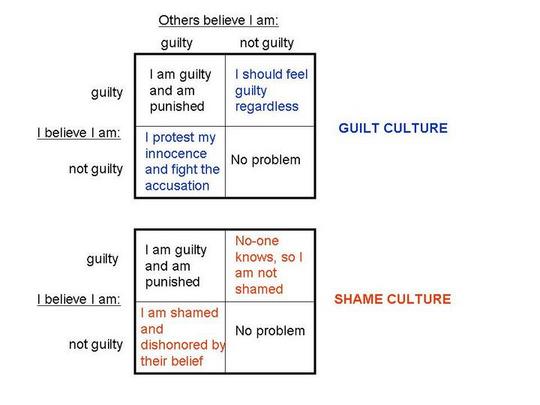
Guilt vs Shame Comparison Chart
Two charts, one for guilt and one for shame with axis what I believe and what others believe. Good short representation of differences between guilt and shame.
Specific behaviors associated with Japan
Japan is the only developed country that is shame-based (all others are guilt-based). japan's reliance on shame to enforce societal rules is often used to explain how such a civilized seeming country was able to participate in such unimaginable atrocities during World War II without sustaining any societal psychological damage.
A good understanding of the way shame works to enforce group ethics and secure group safety is imperative if you wish to understand how to motivate or demotivate Japanese subordinates.
Examples or Articles
Hierarchy - Japan
General behaviors
The belief that challenges are better met, that individuals and the group are more secure when there is a clear chain of command; where those of lower status have clearly understood obligations for performance; and those of higher status have clearly understood duties to protect and make decisions.
In hierarchical cultures requesting assistance from someone in another department or someone senior to an immediate manager or providing updates to anyone other than an immediate manager may be viewed as sneaky or even traitorousby a manager.
Often in cultures with a Hierarchy orientation, subordinates expect to be told what to do and managers do NOT expect to be contradicted they expect to be obeyed without question or discussion.
A further attribute of cultures with a Hierarchy orientation is the belief that information is power, which leads to a perceived unwillingness to share what one knows. In cultures with a Hierarchy orientation, information flows are part of the accepted rules of the hierarchy.
Educational practices are also affected by a cultures Hierarchy orientation. Teachers in cultures with a Hierarchy orientation are figures of authority, they are not to be questioned, they are to be listened too. Learning often does not come from discussion or personal exploration, instead learning comes from memorizing what the teacher and the text book says. In addition, learning to listen, to accept, and not to doubt authority, in school means this particular cultural orientation will change very slowly if at all even when contending with forces for change such as the internet.
This is a Summary, Please click the link for the entire article
This is a Summary, Please click the link for the entire article
Communication Challenges When Hierarchy Meets Loosey-Goosey
Managers and Subordinates from Cultures with hierarchical orientations have clear understandings of what can, cannot, and should be said when they speak to each other. Note, what can, cannot, and should be said may differ from one hierarchical culture to another, but in all such cultures if you don't say what you should or do say what you should not, it is almost guaranteed that your attempted communication will be misunderstood and hence will fail to achieve the desired result.
This short example shows the dangerous possible result when a nurse from a culture with a hierarchical orientation is managed by a doctor from a culture with a Loosey-Goosey orientation.
Specific behaviors associated with Japan
In Japan, everyone has a well defined place in some type of hierarchy: at work, within the family, within the group. Even the Japanese language has forms that should be used depending on your position in the hierarchy; when speaking to someone of higher rank you must use a more polite form of speech. This is one reason why exchanging business cards is so important in Japan; before addressing someone a Japanese person needs to establish if they are equals, of lower status, or of higher status. The business card helps remove any doubt as to your relationship with the person you have just exchanged cards with.
People from Loosey-Goosey cultures often accuse people from Hierarchy cultures of being stubborn (because unless an individual from a Hierarchy culture is dealing with someone of higher status they usually see no need to change their point of view and are often annoyed when their opinion is questioned. In Japan this tendency is often viewed as passive-aggressive because your Japanese counterpart will not contradict you openly but will none-the-less see no reason to compromise.
Examples or Articles
Power Distance - Japan
General behaviors
Power Distance is a measure of the extent to which less powerful members of institutions and organizations accept that power is distributed unequally. At the extreme a person completely accepts a hierarchical concept of society or business and with this accepts that those at the top of the hierarchy have the authority to make decisions that control their lives. In such cultures, the less powerful believe that those in power have their best interests at heart, and have more experience and access to better information than they do.
Examples or Articles
Specific behaviors associated with Japan
Surprisingly Hofstede's researched found Japan to have a slightly below average orientation for Power Distance. This is contrary to the experience of most foreigners working in Japan, who consider the Japanese to have a very high Power Distance orientation.
The difference between Hofstede's research and the experiences of non-Japanese working in Japan may result from the fact that the Japanese who responded to Hofstede's questionnaires interpreted their acceptance of the increased status and authority of their managers (buchos) differently than foreigners would have. The evidence for a high Japanese Power Distance Index is quite strong: it starts in the Japanese family where elders have significant authority over younger members of the nuclear and extended family and it extends into the work place where extreme deference is accorded managers. While some of this apparent deference is due to the Indirect orientation of the Japanese, some to the Risk Averse orientation of the Japanese, and some to the Hierarchy orientation of the Japanese, these alone do not explain the apparent rudeness that Japanese managers often exhibit when dealing with subordinates nor the obedience given by subordinates to managerial decrees.
Examples or Articles
Inherent Goodness of Working Hard - Japan
General behaviors
An individual with a Work orientation, often called work ethic believes in the inherent goodness of working hard. Hard work is considered ’good for the soul’. work is done for work’s sake, not to achieve status, it is simply what one must do. It might also be considered necessary for the good of one’s group.
The Inherent Goodness of Working Hard should not be confused with enjoying work. Individual’s from cultures with this orientation often do not take enjoyment from their work, they feel instead that hard work is their duty what they were born to do.
Examples or Articles
Specific behaviors associated with Japan
It may not be that Japanese workers believe there is inherent goodness in working hard, it may be that they believe it is their duty to make sure that their group accomplishes what is expected of them. The underlying motivation is unclear, what is clear is that Japanese workers will actually work themselves to death to accomplish what is expected of them. They would be shamed if they did not.
Once when I worked in Japan, a virus infected all the computers. The IT staff worked round the clock, never leaving the office, for more than 50 hours, until every PC in the office had a new operating system installed.
The Japanese writer Akio Morito used the following example to describe the Japanese worker’s sense of duty: The day after the Hiroshima/Nagasaki nuclear bombs were dropped on Japan, things, as one might expect, were in total shambles. Just imagine what it would be like to be in acountry where nuclear bombs were being dropped! But Morita wanted to travel back to his home place somewhere far away from Hiroshima. Since the whole country was in mayhem, he was unsure about the travel possibilities per se, but just went to the train station to check out if there was any activity. There, he says, the train came bang on time - exactly on the scheduled time. That, he proudly says, is the classic example of Japanese discipline and sense of duty.
Neutral (Unemotional) - Japan
General behaviors
Neutral (Unemotional) is a measure of how comfortable individuals are sharing their feeling with others, often relative strangers. In Neutral cultures, emotions are carefully controlled, held in check, not publicly displayed. Decisions are most often rational and separated from emotion.
Examples or Articles
Specific behaviors associated with Japan
Examples or Articles
Humility - Japan
General behaviors
Humility is used as a measure of how Individuals describe themselves, their successes, their competencies, and their experience. An Individual with a Humility orientation believes that one should show modesty when discussing successes or not discuss them at all. Humility, also considered as self-deprecation is often seen as a characteristic of extremely relationship-based cultures where it is more a manifestation of not wanting to stick out than it is true humility. Note:- Like collectivism, humility has an individual and institutional dimension.
This is a Summary, Please click the link for the entire article
This is a Summary, Please click the link for the entire article
An Example of Japanese Humility
Read time 3 minutes Think time 5 minutes
In Japan it is considered poor manners to “blow your own horn”. One should often apologize for ones shortcomings and limitations, even if you are considered to be an expert. You will be judged by what you do not what you say you can do or what you have done.
This short excerpt from the Blue-Eyed Salaryman illustrates this behavior.
Power Distance - United States
General behaviors
Power Distance is a measure of the extent to which less powerful members of institutions and organizations accept that power is distributed unequally. At the extreme a person completely accepts a hierarchical concept of society or business and with this accepts that those at the top of the hierarchy have the authority to make decisions that control their lives. In such cultures, the less powerful believe that those in power have their best interests at heart, and have more experience and access to better information than they do.
Examples or Articles
Specific behaviors associated with United States
Examples or Articles
Equality - Egality - United States
General behaviors
Equality - Egality is a measure of the extent to which less powerful members of institutions and organizations do not accept that power is distributed unequally. In such cultures people do not believe that hierarchies benefit either society or business they believe that everyone should have a say in decisions that control their lives or affect the business.
Examples or Articles
Specific behaviors associated with United States
Examples or Articles
Hierarchy - United States
General behaviors
The belief that challenges are better met, that individuals and the group are more secure when there is a clear chain of command; where those of lower status have clearly understood obligations for performance; and those of higher status have clearly understood duties to protect and make decisions.
In hierarchical cultures requesting assistance from someone in another department or someone senior to an immediate manager or providing updates to anyone other than an immediate manager may be viewed as sneaky or even traitorousby a manager.
Often in cultures with a Hierarchy orientation, subordinates expect to be told what to do and managers do NOT expect to be contradicted they expect to be obeyed without question or discussion.
A further attribute of cultures with a Hierarchy orientation is the belief that information is power, which leads to a perceived unwillingness to share what one knows. In cultures with a Hierarchy orientation, information flows are part of the accepted rules of the hierarchy.
Educational practices are also affected by a cultures Hierarchy orientation. Teachers in cultures with a Hierarchy orientation are figures of authority, they are not to be questioned, they are to be listened too. Learning often does not come from discussion or personal exploration, instead learning comes from memorizing what the teacher and the text book says. In addition, learning to listen, to accept, and not to doubt authority, in school means this particular cultural orientation will change very slowly if at all even when contending with forces for change such as the internet.
This is a Summary, Please click the link for the entire article
This is a Summary, Please click the link for the entire article
Communication Challenges When Hierarchy Meets Loosey-Goosey
Managers and Subordinates from Cultures with hierarchical orientations have clear understandings of what can, cannot, and should be said when they speak to each other. Note, what can, cannot, and should be said may differ from one hierarchical culture to another, but in all such cultures if you don't say what you should or do say what you should not, it is almost guaranteed that your attempted communication will be misunderstood and hence will fail to achieve the desired result.
This short example shows the dangerous possible result when a nurse from a culture with a hierarchical orientation is managed by a doctor from a culture with a Loosey-Goosey orientation.
Specific behaviors associated with United States
Examples or Articles
Loosey-Goosey (The opposite of Hierarchy) - United States
General behaviors
Loosey-Goosey cultures believe that hierarchies impose artificial and negative constraints on creativity and simply getting the job done. People with this cultural preference believe that challenges are best met if individuals can work with whomever can be the most help without having to first apply for approval no matter where they are positioned in the organization. Because resources can be requested by anyone, subordinates work as easily with multiple managers as they do with a single manager. Loosey-Goosey cultures will readily adopt matrix management if matrix management seems the best approach to a particular need. Loosey-Goosey cultures often leave much of the responsibility of keeping managers updated in the hands of subordinates. Note permission is not required from their immediate supervisor to request assistance from someone higher in the organization than their supervisor.
Often in cultures with a Loosey-Goosey orientation, subordinates expect to contribute and have a say in most decisions and managers act more as facilitators soliciting inputs and discussion prior to recommending (as opposed to decreeing) a course of action.
Cultures with a Loosey-Goosey orientation tend to consider information to be part of the public domain and not the sole property of any one individual or sector. If information is needed from another department within the organization, for instance, it is expected that such information would be shared openly in order to get the job done.
Educational practices are also affected by a cultures Loosey-Goosey orientation. Teachers in cultures with a Loosey-Goosey orientation may be figures of authority, still they be questioned, and their ideas may not only be challenged but they are supposed to challenge the teachers ideas. Learning comes from discussion or personal exploration, not learning memorizing what the teacher and the text book says. In addition, learning to discuss, to debate, and to doubt authority, in school means this particular cultural orientation will change very slowly if at all even when contending with forces for change such as the internet.
This is a Summary, Please click the link for the entire article
This is a Summary, Please click the link for the entire article
An American Managing in Hong Kong
The experiences of an American working for a British-Hong Kong company, managing an all Hong Kong Chinese staff illustrate some strategies for working effectively when hierarchy and power distance clash with oosey-goosey and equality.
Specific behaviors associated with United States
Examples or Articles
Individualism - United States
General behaviors
Individualism is a measure of the extent to which people look after themselves and their immediate family. In cultures that are individualistic, individuals believe that challenges are better met,that individuals and the group are better served, when a person’s first responsibility is for the safety and improvement of his or her self. Conformity is often viewed negatively in a culture with an Individualism orientation.
Current cultural models now include several types of Individualism: Single person, nuclear family, extended family, and group (for example a kibbutz or corporation). The behaviors and expectations of individuals from Group and Extended Family individualism cultures (not Single Person) are different and are described separately.
This is a Summary, Please click the link for the entire article
This is a Summary, Please click the link for the entire article
Individualism–collectivism and group creativity
Current research in organizational behavior suggests that organizations should adopt collectivistic values because they promote cooperation and productivity, while individualistic values should be avoided because they incite destructive conflict and opportunism. In this paper, we highlight one possible benefit of individualistic values that has not previously been considered. Because individualistic values can encourage uniqueness, such values might be useful when creativity is a desired outcome. Although we hypothesize that individualistic groups should be more creative than collectivistic groups, we also consider an important competing hypothesis: given that collectivistic groups are more responsive to norms, they might be more creative than individualistic groups when given explicit instructions to be creative. The results did not support this competing hypothesis and instead show that individualistic groups instructed to be creative are more creative than collectivistic groups give
Specific behaviors associated with United States
Examples or Articles
Collectivism - United States
General behaviors
Cultures that are considered to be collectivist believe that if people look after the good of the group the group will reciprocate and look after them, that is, the group will protect them, and give them security in exchange for their loyalty to the group. Collectivist cultures believe that everyone will be better off if everyone puts the good of the group ahead of their own good. Uniqueness is often viewed as a form of deviance and conformity is associated with harmony. This description applies to individuals and the nuclear family.
Current cultural models now include several types of collectivism in addition to the beliefs of the individual and the nuclear family, these are: extended family collectivism (which is very strong in China where the extended family looks out for its own good, but within the extended family, family members are expected to put the family’s good before themselves), group collectivism, and institutional collectivism (such as in Sweden where some things are treated as me first but government programs in education and health care are also supported.
Examples or Articles
Specific behaviors associated with United States
Examples or Articles
Considering Ideas and Using Intuition to Solve Challenges - United States
General behaviors
Considering Ideas and Using Intuition to Solve Challenges is a measure of what individuals believe is the most effective way to identify possible solutions to problems/challenges. Individuals from cultures with an A Considering Ideas and Using Intuition to Solve Challenges orientation, first think about the problem/challenge abstractly, brainstorm, come up with ideas, use their intuition as a guide to the best approach.
Individuals from cultures with this orientation often insist on discussing and understanding the big picture before considering details.
Examples or Articles
Specific behaviors associated with United States
Examples or Articles
Self-Promotion - United States
General behaviors
Self-Promotion is used as a measure of how Individuals describe themselves, their successes, their competencies, their experience. An Individual with a Self-Promotion orientation is comfortable openly discussing, playing up and praising their success. An Individual from a culture with a Self-Promotion orientation believes one must blow one’s own horn in order to get ahead and get noticed. Humility is often considered a sign of weakness.
Examples or Articles
Specific behaviors associated with United States
Examples or Articles
Tasks Most Important - United States
General behaviors
Tasks Most Important is a measure of how an individual plans projects. Tasks Most Important cultures believe that proper planning, proper segmenting of projects, proper scoping of segments (defining task deliverables) and proper scheduling of segments makes human resourcing less critical. Such cultures believe that if a project is properly structured anyone with the necessary skills can fill the identified positions. Cultures with this preference do not believe that task segmenting, scoping, and scheduling will change depending on who makes up the project team.
Such cultures also consider successful task completion to take precedence over family concerns or concerns of friends or colleagues.
Examples or Articles
Specific behaviors associated with United States
American’s do not believe anyone can do anything day one, however, they do believe that smart people with some appropriate knowledge, can come ’up to speed’ quickly. American’s believe that many individuals have the ability to perform most tasks but without proper planning, scheduling, and properly segmenting projects in tasks, nothing is likely to be accomplished.
Pert Charts that show critical paths and Gantt charts that show who is doing what when are believed to be essential for the success of a project.
Historically, such planning became famous as a result of Admiral Rickover’s on time implementation of America’s first nuclear submarine. In a time infamous for defense development time and money overruns, Admiral Rickover completed the production of America’s first nuclear submarine on time and under budget. He claimed his success was due to meticulous planning using Gantt and Pert charts.
Examples or Articles
Monochronic - United States
General behaviors
Monochronic is a measure of how an individual schedules his or her own day and how the individual subconsciously prioritizes scheduled activities and reacts to disruption in the schedule.
Individuals from Monochronic cultures (also called Sequential) tend to do one thing at a time, they concentrate on the job at hand, they tend to think about when things (as opposed to what things) must be achieved. Individuals from Monochronic cultures often undertake careful planning and scheduling and consider ’time management’ to be important.
Examples or Articles
Specific behaviors associated with United States
Americans are all about setting and meeting deadlines. Nothing is supposed to get in the way of completing a task on time; not family matters, needs of friends, not even nature or acts of God. Changing project requirements, also called creeping functionality are intensely disliked by developers who see such changes as negatively affecting their project schedules. Development contracts often restrict the possibility of changes or make changes difficult to adopt by having ridged change processes including increases in costs. Pert Charts that show critical paths and Gantt charts that show who is doing what when are believed to be essential for the success of a project.
Examples or Articles
Pursuit of Career Success - United States
General behaviors
Pursuit of Career Success is a measure of what an individual believes is most important in life. In Pursuit of Career Success cultures, doing well at ones job is valued more than spending time with ones family or friends or attaining personal fulfillment. Individuals from Pursuit of Career Success cultures usually value power, money, things, or status over free time, family time, and self-actualization.
This is a Summary, Please click the link for the entire article
This is a Summary, Please click the link for the entire article
Irreconcilable differences at the end of the day: Men, women and housework
Whenever an individual is driven to achieve two opposed cultural dimensions, stress is the likely result. While this almost always occurs in multi-cultural situations, it can also result within a single culture; the United States is a good example. Traditionally the United States has had a Pursuit of Career Success orientation. During the past 20 years, however, this has started to change. The same can also be said about the US’s Masculinity orientation. Today many American men and women desire to have both a successful career and ample time to spend with friends, family, and the pursuit of self-actualization, AND many women feel their spouses should pitch in with the housework and child rearing. This has resulted in significant stress for both spouses.
Quality of Life - United States
General behaviors
Quality of Life is a measure of what an individual believes is most important in life. Cultures with a Quality of Life orientation believe one works to live as oppose to lives to work. Such cultures view work as something necessary but only to the extent that one does ones fair share and is compensated enough to support doing the important things in life. Individuals from cultures with a Quality of Life orientation value friendship, free time, family time and self-actualization as the really important things in life.
Examples or Articles
Specific behaviors associated with United States
Currently the United States is undergoing a gradual shift from a Pursuit of Career Success orientation to a Quality of Life Orientation. Attempting to achieve two opposing cultural orientations usually results in significant stress and this is in fact the case in the US.
This is a Summary, Please click the link for the entire article
This is a Summary, Please click the link for the entire article
Irreconcilable differences at the end of the day: Men, women and housework
Whenever an individual is driven to achieve two opposed cultural dimensions, stress is the likely result. While this almost always occurs in multi-cultural situations, it can also result within a single culture; the United States is a good example. Traditionally the United States has had a Pursuit of Career Success orientation. During the past 20 years, however, this has started to change. The same can also be said about the US’s Masculinity orientation. Today many American men and women desire to have both a successful career and ample time to spend with friends, family, and the pursuit of self-actualization, AND many women feel their spouses should pitch in with the housework and child rearing. This has resulted in significant stress for both spouses.
Direct (Truth and Honesty) - United States
General behaviors
Direct (Unambiguous Truth and Honesty) is a measure of an individual’s value of clarity and unambiguousness even at the possible expense of others feelings or the possible risk of resulting conflict.
In cultures valuing Directness, words are taken at face value, no attempt is made (or need be made) to interpret their meaning either based on situational factors or nuance.
This is a Summary, Please click the link for the entire article
This is a Summary, Please click the link for the entire article
The Benefits of Conflict and Argument
This example describes the benefits of constructive arguments. It also describes problems that often arise due to either destructive arguments or the avoidance of arguments. This is a good description from the perspective of a culture with a Direct Orientation and a somewhat emotional orientation.
Destructive arguments are defined as those that are primarily name-calling, screaming, insulting, bringing up old baggage, feeling compelled to have the last word, or inclining towards violence.
Recent studies have also shown that argument avoidance on the part of one or both parties to a conflict also leads to bad outcomes (divorce in the case of marriages).
It would seem all parties to a dispute need to be willing to argue civilly if the dispute is to be successfully resolved. It would be interesting to find research on how disputes are recognized and resolved in cultures with an indirect and unemotional orientation.
Achievement - United States
General behaviors
Achievement is a measure of how status is accorded to people. Achievement means that people are judged on what they have accomplished and on their record.
Achievement-oriented societies or organizations justify their hierarchies by claiming that senior people have ’achieved more.’
In an achievement-oriented culture people will ask what you studied.
Some examples:
Use of titles only when relevant to the competence brought to a specific task
Respect for superior in hierarchy is based on how effectively his/her job is performed and how adequate their knowledge.
Most senior managers are of varying age and gender and have shown proficiency in specific jobs
If you come from a culture with an Ascription-orientation and you are working with subordinates from a culture with an achievement-orintation
Respect the knowledge and information of the achievers, even if you suspect they are short of influence.
Use the title that reflects how competent you are as an individual.
Do not underestimate the need of the achievers to do better or do more than is expected.
Examples or Articles
Specific behaviors associated with United States
Examples or Articles
Doing, Accomplishing is Best - United States
General behaviors
Doing, Accomplishing is Best, is used as a measure of an Individual’s immediate reaction to a challenge: is their natural inclination to immediately start doing something, to wait and see if the challenge will be met over time without taking any action, or by planning and thinking about the best course of action.
In a culture with a Doing, Accomplishing is Best orientation, the natural and preferred mode of activity is to be continually engaged in accomplishing tangible tasks.
The opposites of a Doing orientation are Being or Thinking.
Examples or Articles
Specific behaviors associated with United States
Examples or Articles
Universality - United States
General behaviors
Individuals from Universalist cultures believe that ideas, practices, and rules can and should be applied everywhere without modification without considering who they are applied to or under what circumstances. An example often cited is ’If you were in a car driven by a friend, the friend was going 40 mph in a 25 mph zone, your friend hit a pedestrian, you were the only witness, and your friend’s lawyer asks you to, under oath, testify that your friend was only driving 25 mph, what would you do?’ Individuals from a culture with a Universalist orientation, such as the United States, would tell the truth.
Examples or Articles
Specific behaviors associated with United States
Examples or Articles
High Territoriality - United States
General behaviors
Territoriality is a measure of an individual’s belief about the best way to distribute, allocate, and control material resources. In High Territorial cultures individual’s believe material things should be owned and that there should be clear physical boundaries of control. Individuals in High Territoriality cultures, often require a large personal space to feel comfortable.
Examples or Articles
Specific behaviors associated with United States
Examples or Articles
Integrating Approach to Solving Problems - United States
General behaviors
An individual with an Integrating Orientation believes that the best solutions will be identified or imagined if one starts by identifying as much detail as possible and then attempts to understand how the details fit together to form a complete picture. Such individuals finally agree on what the goal should be after integrating all the details and components. This is also know as Inductive reasoning.
Examples or Articles
Specific behaviors associated with United States
Examples or Articles
Low Context - United States
General behaviors
Low Context cultures are characterized by a need to give detailed verbal information to achieve successful communication.
Individuals from Low Context cultures often feel those from High Context cultures are sly, non-communicative, passive-aggressive, or lack an opinion.
Examples or Articles
Specific behaviors associated with United States
Examples or Articles
In-Group Individuality - United States
General behaviors
In-Group Individuality is just another indication of an Individualism orientation. Some cultures are completely individualistic, believing that challenges are better met,that individuals and the group are better served, when a person’s first responsibility is for the safety and improvement of his or her self. In-Group Individuality is included in this orientation.
Some cultures believe that their well-being is tied to the protection afforded by a small group (In-Group Collectivism) where the small group believes its interests are best served by looking out for itself, or can identify with a large.
Some cultures have a collectivism orientation. ’ “ ”